

Today I was watching a video of Jon Gray, President of Blackstone, presenting to a room full of investors. The title of his talk was borrowed from an old American burger ad — “Where’s the Beef?” absolutely loved the video, especially the delivery.
The question he was answering is the one every sceptic is asking right now. Hundreds of billions are going into GPUs, data centres and power — so where is the payoff? Gray’s answer was to open up Blackstone’s own portfolio and show what AI was doing to productivity, costs and revenue inside real businesses. Not forecasts. Receipts.
I’ll be honest — my first reaction was a bit uncomfortable. I have been nodding along to the AI story in Indian markets for a year now (mostly from the comfort of conference call highlights and Twitter threads), and I had never once checked whether the companies I track were showing any real RoAI (a little word play is essential for a healthy post :P). Every investor presentation now has one — let’s call it The AI Slide. A brain icon, some circuits, the word “agentic” somewhere, and a promise.
So the obvious questions —
Is anyone in India actually showing numbers? Is it only the IT companies? Is AI saving money, making money, or just costing money right now?
There was only one way to find out. Read everything.
How I ran the screen
Step 1 — I took the Nifty 500 and pulled every announcement filed on NSE between 20 April and 20 October 2026. Six months. That covers the Q4 FY26 results season, the full Q1 FY27 season, and the start of Q2.
Step 2 — From those, I kept only the documents where managements actually say things: earnings call transcripts, investor presentations and press releases. That came to 3,649 PDFs from 475 companies — 924 transcripts, 853 presentations and 1,785 press releases. (My laptop did not enjoy this. 7.5 GB of PDFs.)
Step 3 — I searched every page for AI words — AI, GenAI, agentic, LLM, machine learning, copilot — and pulled out the paragraph around each mention. 312 companies mentioned AI at least once. That’s 9,074 passages.
Step 4 — Then the easiest part. I made my Claude read them. A lot of the 312 fell away immediately — analysts asking “what’s your AI strategy?” and getting a polite non-answer, real estate developers talking about whether AI will hurt IT hiring in Bangalore, and my favourite false positive, agrochemical companies where “AI” means Active Ingredient. 😊
That left 198 companies saying something real about AI in their own business. Each one went into three buckets — the same three Gray used. Productivity is doing more with the same people. Cost is doing the same with less money. Growth is new revenue that would not exist without AI.
And then the most important filter, which I’m calling The RoAI Test. If management put a hard number on it, tied to AI — that’s RoAI. If they named specific tools, agents or deployments but gave no number — that’s just Recipe. And if it’s “AI is a key pillar of our strategy” and nothing else — that’s the Menu Card.
Here’s how the 198 came out:
Companies Talk about AI-led productivity 144
Talk about AI-led cost reduction 65
Talk about AI-led new growth 115
RoAI (hard numbers) 48
Recipe (named deployments) 86
Menu Card (commentary only) 64
Read that again. Out of 500 of India’s largest companies, 48 have put a number on what AI is doing for them. Less than 1 in 10.
But those 48 are very interesting. Let me take you through what I found, theme by theme.
Theme 1: Productivity — The Same Bench, More Runs
The cleanest way to spot AI productivity is not to look at the AI slide at all. Look at two numbers side by side — business growth and headcount growth. If the first runs far ahead of the second, something is doing the work.
Capri Global put it more bluntly than anyone else in the six months:
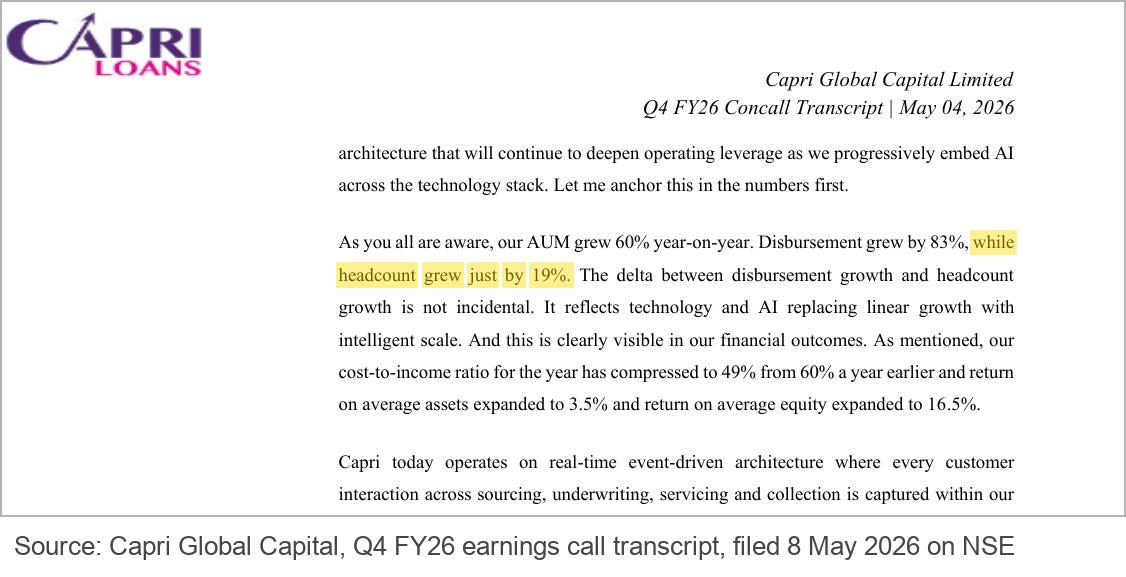
Disbursements up 83%, headcount up 19%, and cost-to-income down from 60% to 49% in a year. Management’s own words — “technology and AI replacing linear growth with intelligent scale.” For a lender, an 11-point fall in cost-to-income is a big deal — a good chunk of it flows down to RoA, which went to 3.5%.
Tata Capital gave the most granular disclosure I came across:
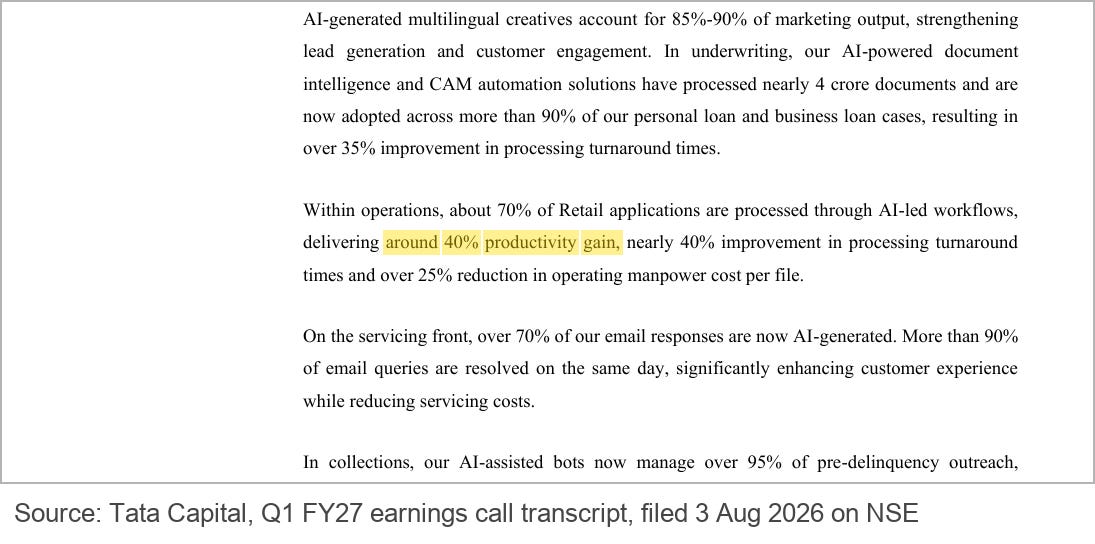
About 70% of retail loan applications now go through AI-led workflows — ~40% productivity gain, ~40% faster turnaround, and over 25% lower manpower cost per file.
And then the IT side, where Tech Mahindra did something I respect — they started measuring only the AI part of productivity, separately from everything else:
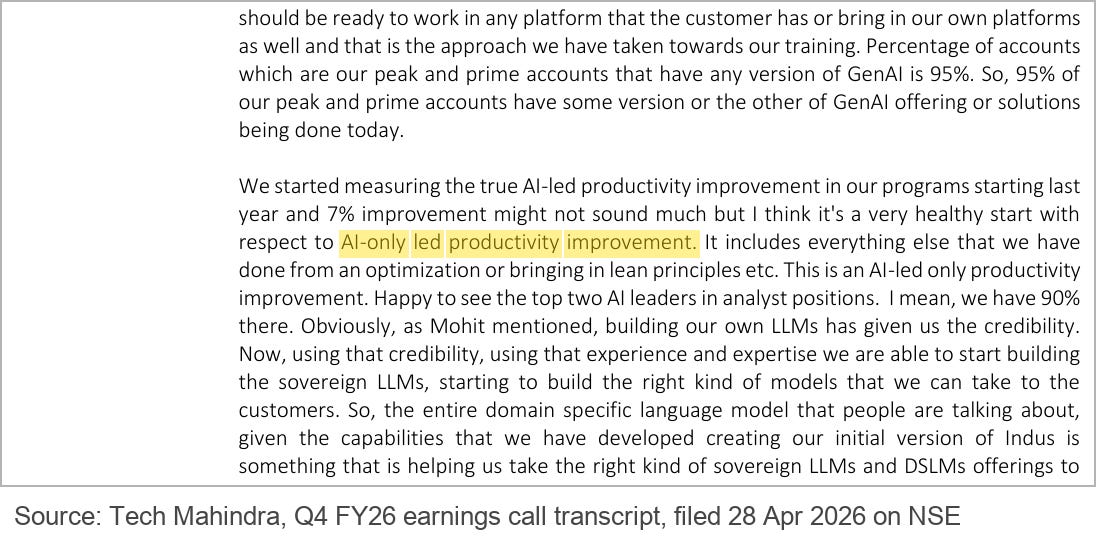
7% improvement in revenue per employee attributed to AI in FY26. Management themselves said it “might not sound much.” Fair. But it’s a real number, measured honestly, and on a cost base of their size 7% is serious money. (I would take one honest 7% over ten slides of “transformational impact”.)
Others in the Productivity bucket with numbers — Birlasoft (25–30% delivery productivity, 50% effort saved using GitHub Copilot), Motilal Oswal (70–80% engineering productivity uplift), Angel One (over 75% of code AI-enabled), Meesho (2x+ engineering productivity) and HDFC Life (31% higher frontline sales productivity).
Theme 2: Cost — The ₹10 Collection Call
If there is one sector in India where AI has already moved from the Menu Card to the plate, it is lending — and specifically, collections.
It makes sense when you think about it. Collections is the most people-heavy part of an NBFC’s P&L. It is repetitive (call, remind, follow up, call again), rule-based (which bucket, how many days past due), measurable to the rupee, and in India it has to happen in a dozen languages. That is almost a job description for a voice bot.
L&T Finance gave the number that stopped me:
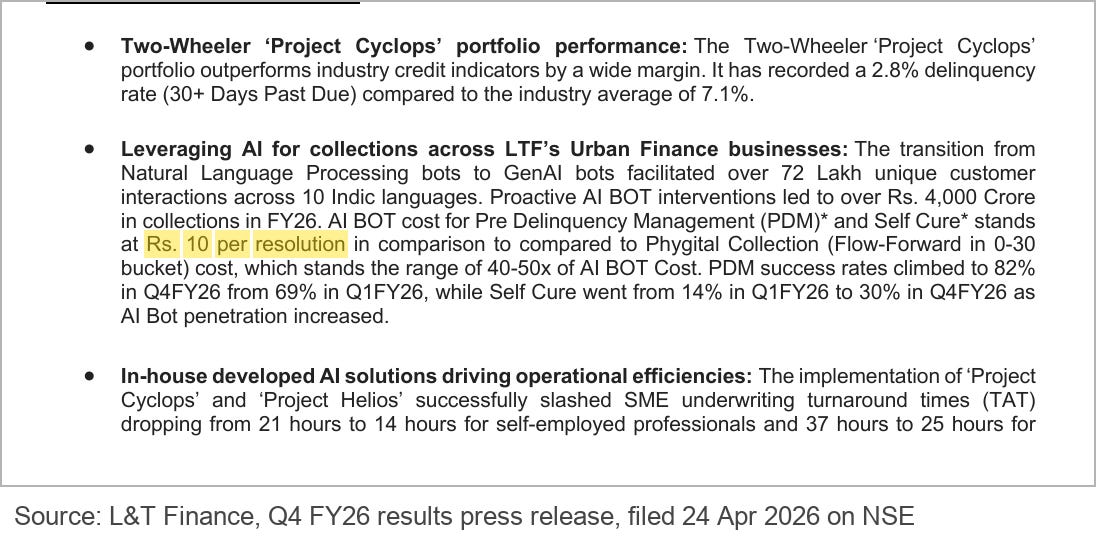
₹10 per resolution using AI bots, against a human-plus-field collection cost that runs 40–50x higher. Over ₹4,000 Cr collected through AI bots in FY26, across 10 Indian languages.
Poonawalla Fincorp had a similar story with two clean numbers:
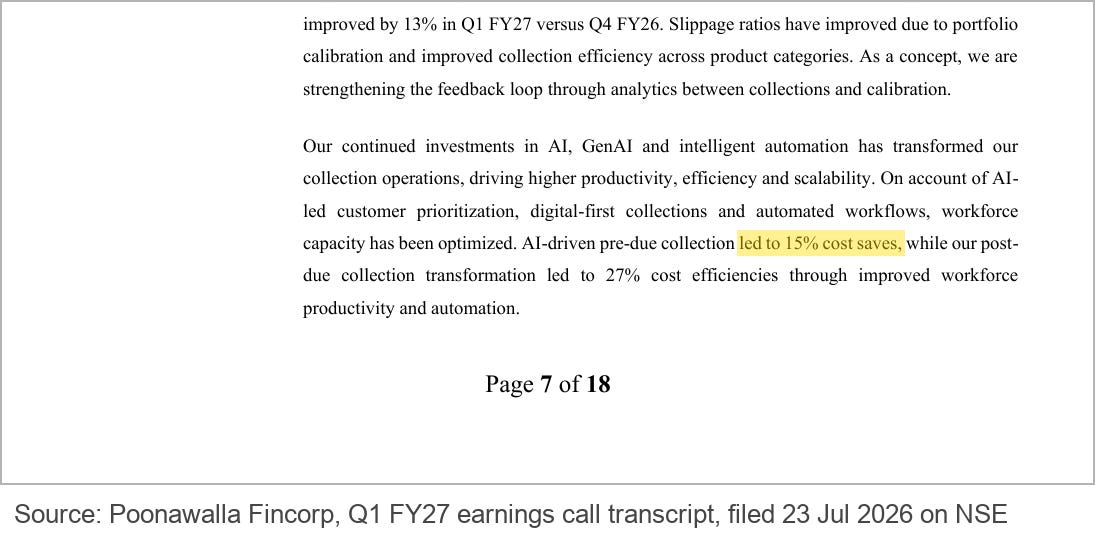
15% cost saving on pre-due collections, and 27% cost efficiency on post-due collections.
Then IIFL Finance (agentic collection calls, plus ~₹450 Cr a month of loans sourced from AI-generated leads), M&M Financial (their in-house agent “Samur.AI” now covers 45% of central processing operations, up from 20% a quarter earlier) and UTI AMC (an AI contact centre answering 59% of inbound calls). The pattern is the same everywhere — the back office goes first.
My favourite outside of finance — PhysicsWallah:
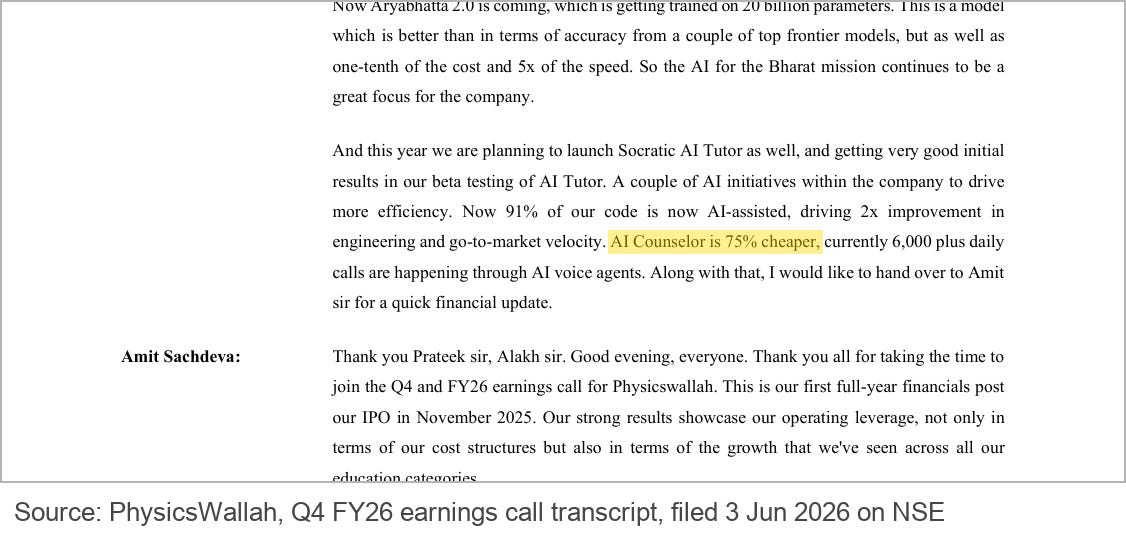
Their AI counsellor is 75% cheaper and handles 6,000+ calls a day, and 91% of their code is now AI-assisted. An ed-tech company that sells to price-sensitive students, using AI to take cost out of the most expensive part of selling — the counselling call. That’s a business model point. The tech is almost secondary.
Theme 3: Growth — Selling AI vs Selling Shovels
Growth is where things split into two very different stories, and it’s worth keeping them apart.
Selling AI. These are companies earning revenue from AI work for clients. The IT majors have started disclosing AI revenue as a separate line — which is the single biggest change in Indian disclosures this year:
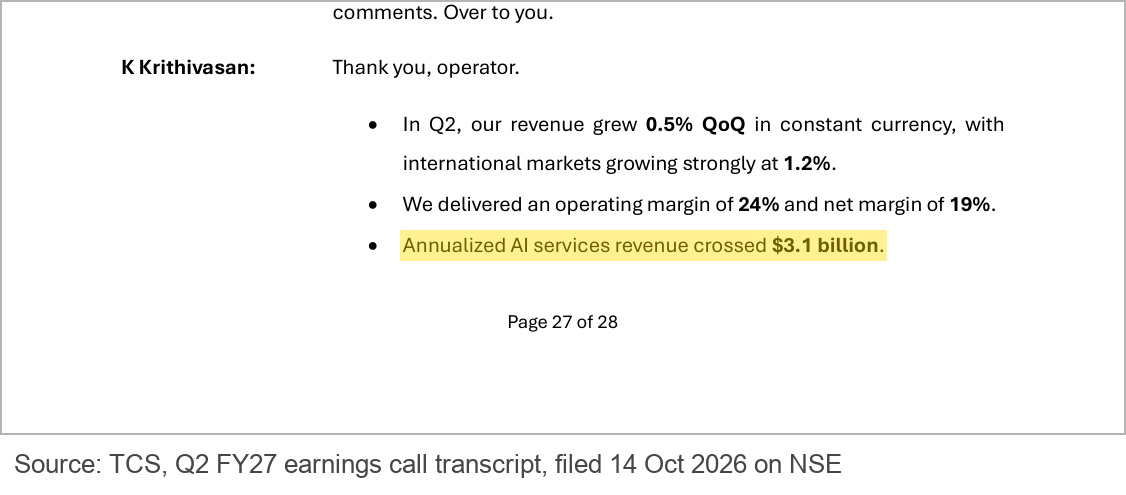
TCS — annualised AI services revenue above $3.1 billion, up from $2.6 billion just one quarter earlier. HCLTech — “Advanced AI” revenue at $219M for the quarter, up 78% YoY. Infosys — AI is 8.2% of total revenue. Coforge — AI-led engineering is now half their revenue. LTM — Enterprise AI plus Business AI revenue up 47%.
Selling Shovels. In every gold rush, the people selling shovels get paid first. In India, the shovel sellers are making servers, fibre, cables and power for data centres. Netweb was the most dramatic:
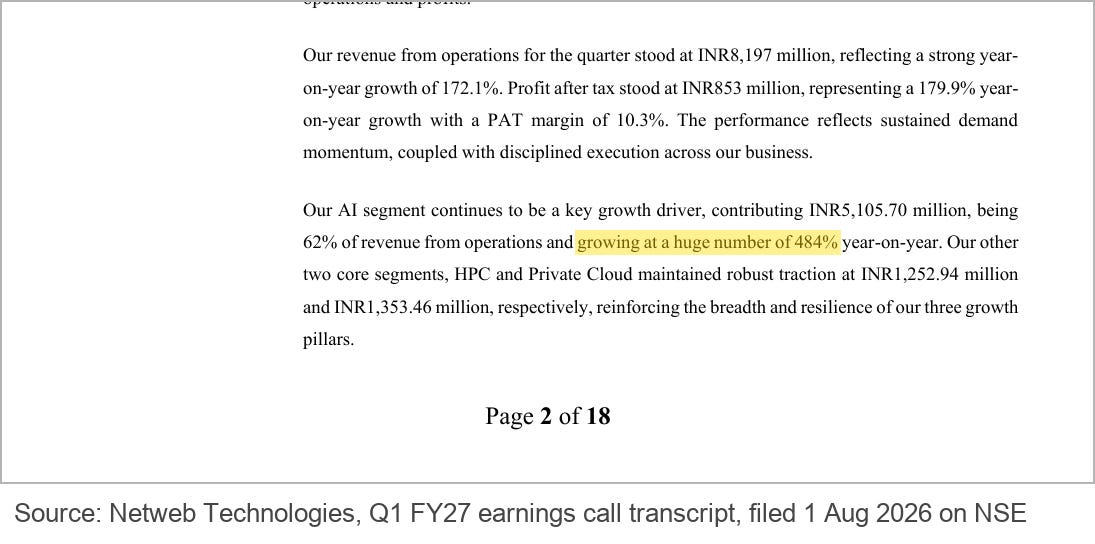
AI systems are 62% of Netweb’s revenue, growing 484% year on year. STL Tech signed a $1.1 billion multi-year deal with a hyperscaler for AI data centre fibre. CleanMax has 42% of its contracted renewable capacity tied to Data & AI customers. MTAR got its first export order for AI data centre assemblies. Redington says 36–41% of its India commercial PC revenue is now AI PCs.
A word of caution here. In the shovel bucket, a lot of the cable, power equipment and chemicals companies mention “AI data centres” as a demand driver — but most of it is Menu Card. “Data centres will need a lot of our product” is a story — it becomes a number only when the order shows up. I only counted the ones where the order or the revenue is already visible.
Theme 4: The Bill Comes to the Table
This is the part nobody puts on The AI Slide — and honestly, it was the most educational part of the whole exercise for me.
The Deflation Tax. If AI makes an IT company’s engineers 30% more productive, who keeps that 30%? Mostly not the IT company. Clients know about AI too, and they are asking for the savings. Mphasis said it plainly:
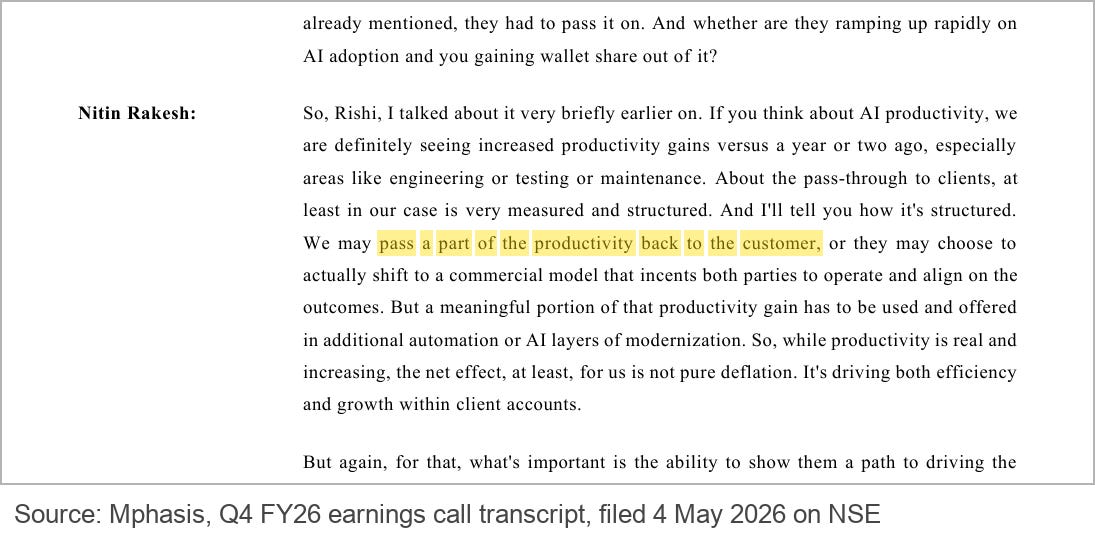
On LTM’s July call, analysts were asking whether 15–20% AI deflation is already built into deal pricing. Wipro and Sagility made the same point in different words. So for IT services, AI is both the biggest growth line and the biggest pricing risk — at the same time. This is why the AI revenue numbers above look great while topline growth for most IT majors is still low single digits.
The AI Victim. Some businesses are on the wrong side of AI. Info Edge was refreshingly candid about Shiksha:
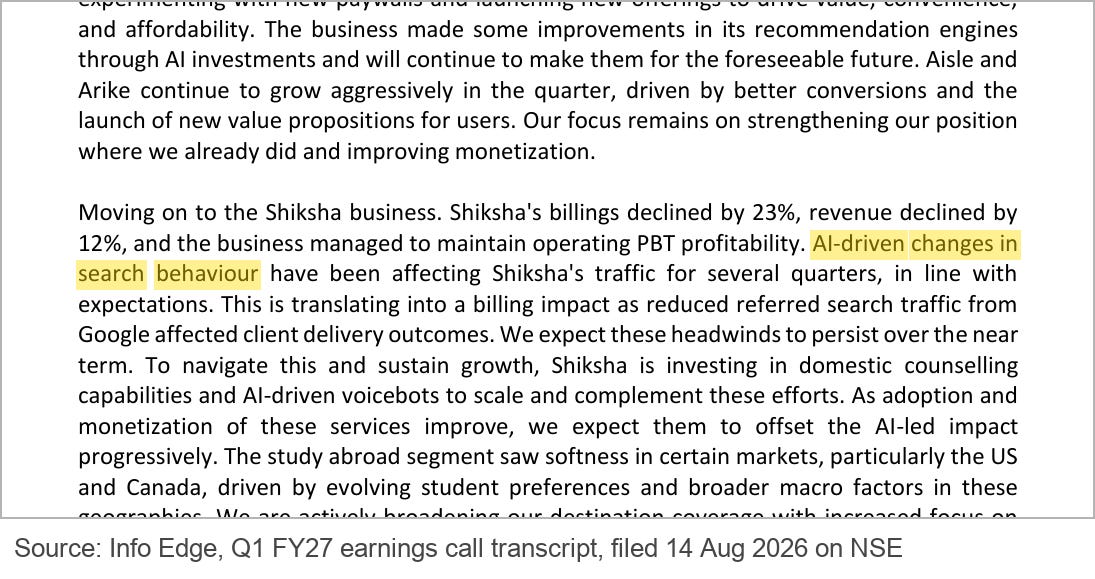
Shiksha’s billings down 23%, revenue down 12% — because AI answers (in Google itself and in chatbots) mean fewer students click through to a college portal. Any business that lives on search traffic should be reading this paragraph twice.
The AI Bill. And for some, AI is just a cost line for now. Groww pointed to new AI-related and compute costs when explaining why a cost line went up. Cholamandalam said AI investments are adding to cost and they would not bake in efficiencies yet. JM Financial said token costs “can go up like crazy”. All three are just being honest — the bill always arrives first, the RoAI later (if at all).
How I now read an AI paragraph
If you take one thing from this post, take this checklist. It’s what I’ll use for every earnings call from here on:
Is there a number? If not, it’s Menu Card. Move on.
Is the number tied to a P&L line? “40% productivity gain” is good. “25% lower manpower cost per file” is better.
Does it show up in cost-to-income, opex/AUM or revenue per employee? If AI is real, it will show up there within 2–3 quarters.
Who keeps the gain — the company or its client? Lenders keep it. IT services mostly share it.
Do they repeat the number next quarter? A metric that disappears after one quarter was just a slide.
So where’s the RoI of AI in India?
It’s in the lenders’ back offices, in collections calls running at ₹10 a pop, in a few IT companies honest enough to measure AI on its own, and in the companies selling shovels to the data-centre boom. It is not — yet — in most of the Nifty 500, where AI is still a strategy slide and a hiring plan.
That’s not a bad thing. It just means the market can’t tell the difference yet — and that’s usually where the opportunity is.
DISCLAIMER: I AM NOT A SEBI-REGISTERED ADVISOR OR A FINANCIAL ADVISOR. ALL THE VIEWS ARE FOR EDUCATIONAL PURPOSES. I MAY OR MAY NOT HAVE INVESTED IN THESE STOCKS. PLEASE DO YOUR DUE DILIGENCE YOURSELF. THIS IS NOT A STOCK RECOMMENDATION.